Online Training
Master in Environmental Management

1800 hours


Spanish
Educational institutions

$1.674.100
Request information


Online Training
1800 hours
Spanish
Educational institutions
Request information
Multilingual support
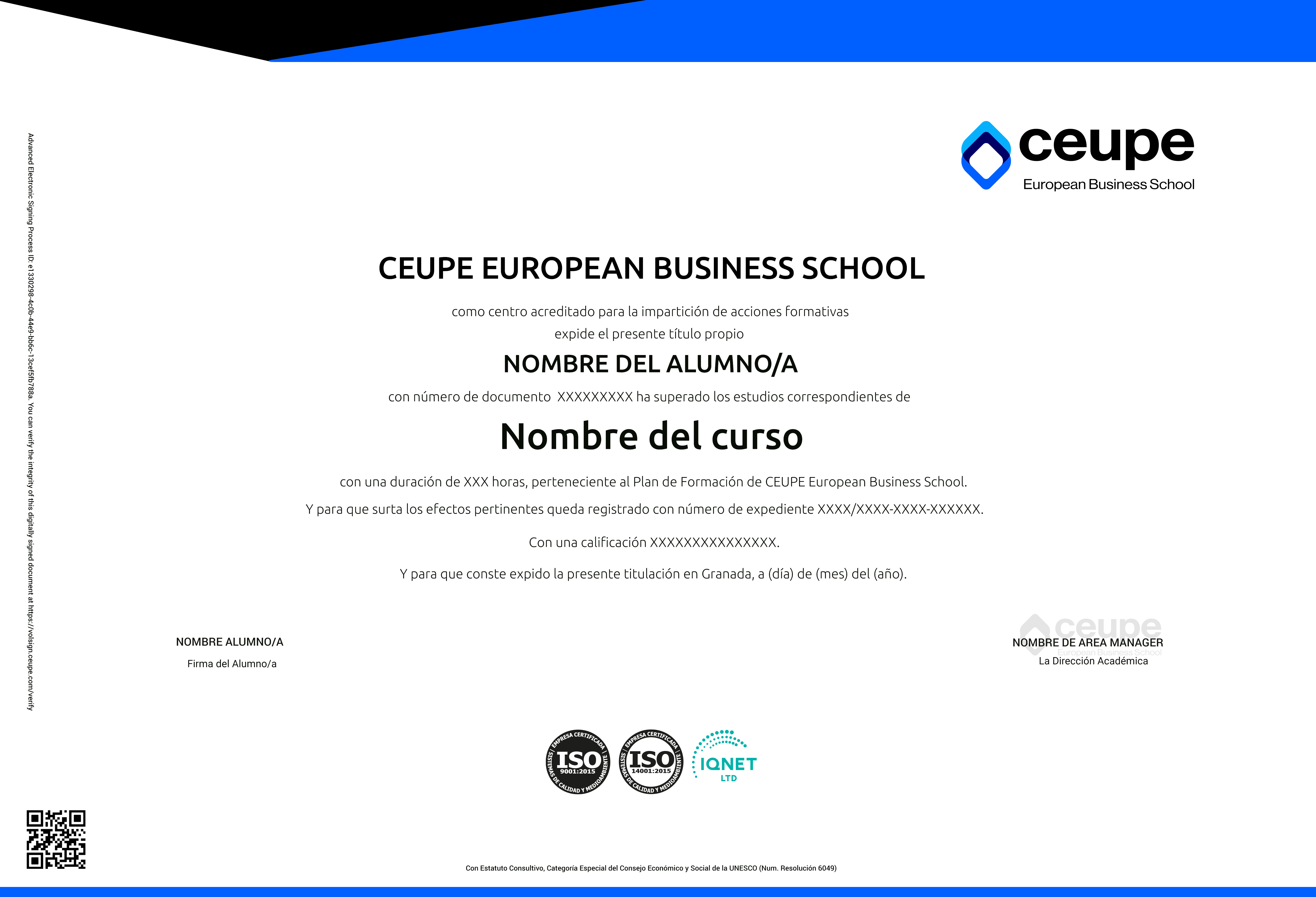
Digital certificate included
Assistant Phia
- Acquire in-depth knowledge and practically apply various techniques, methods and market tools related to the treatment and management sectors of water, soil, waste, atmosphere and acoustic pollution. This allows them to develop skills and competencies in the design and implementation of effective strategies to address and reduce the negative environmental impact of business activities. Develop a deep understanding of current and future challenges related to environmental management, and be aware of the latest trends and practices in the field. - Develop skills in various techniques, methods and market tools related to pollution management and treatment of water, soil, waste, atmosphere and acoustics. - The program seeks to train students in the design, implementation and evaluation of environmental management plans, with a focus on prevention, mitigation and adaptation to climate change. - Know in depth the origin, typology, characteristics, evolution, regulations, corrective and preventive measures in the management of natural and industrial waste. - Learn to use tools and techniques for measuring, analyzing and monitoring the environmental impacts of business activities, as well as for evaluating the effectiveness of the management measures adopted. - The various pollutants, their behavior and underlying causes will be addressed. Potential risks and damages will be evaluated and application techniques for improved decontamination will be focused on. - Acquire knowledge and practical skills in the implementation and evaluation of environmental management systems according to ISO 14001 and European EMAS Regulations, considering the analysis of current indicators, methods and implementation strategies. - Understand the legal and regulatory framework that regulates environmental management, and be able to apply the relevant laws and regulations in the business context.
- Environmental consulting companies: you can work in specialized environmental consultancies that provide advisory services to companies in relation to waste management, regulatory compliance, carbon footprint, among other topics. - Renewable energy companies: you can work in companies dedicated to generating energy through renewable sources such as solar, wind, hydroelectric or geothermal. - Public administration: you will be able to work in public organizations, such as ministries, ministries, agencies and commissions dedicated to environmental protection and waste management. - Manufacturing companies: you will be able to work in manufacturing companies that seek to improve their environmental practices and reduce their environmental impact through waste management, recycling and conservation of natural resources. - Non-governmental organizations: you can work in non-profit organizations dedicated to environmental conservation and the promotion of sustainable practices, such as Greenpeace or WWF. - Academic institutions: you can work in universities and research centers as a professor or researcher specialized in environmental management and sustainability. - Environmental services companies: you can work in companies that offer environmental services, such as waste management, cleaning of natural spaces, wastewater treatment, among others. - Sustainable tourism companies: you can work in sustainable tourism companies, which seek to promote responsible and sustainable tourism, minimizing the environmental impact of tourist activity.
This master's degree in the environment is designed to prepare students to address contemporary and future environmental challenges with a practical and in-depth approach. By acquiring detailed knowledge and applying various techniques, methods and market tools, participants develop crucial skills in designing and implementing effective strategies to reduce the negative environmental impact of business activities. The program provides a solid understanding of the pollution treatment and management sectors in key areas such as water, soil, waste, atmosphere and acoustics. Additionally, it focuses on the design, implementation and evaluation of environmental management plans with special emphasis on prevention, mitigation and adaptation to climate change. Students also become familiar with the legal and regulatory framework that regulates environmental management, allowing them to apply relevant laws and regulations in a business context. In addition, they acquire practical skills in the implementation and evaluation of environmental management systems according to international standards such as ISO 14001 and the European EMAS Regulation.