Online Training
Diploma in International Financial Economics

380 hours


Spanish
Educational institutions

RD$ 38,600
Request information


Online Training
380 hours
Spanish
Educational institutions
Request information
Multilingual support
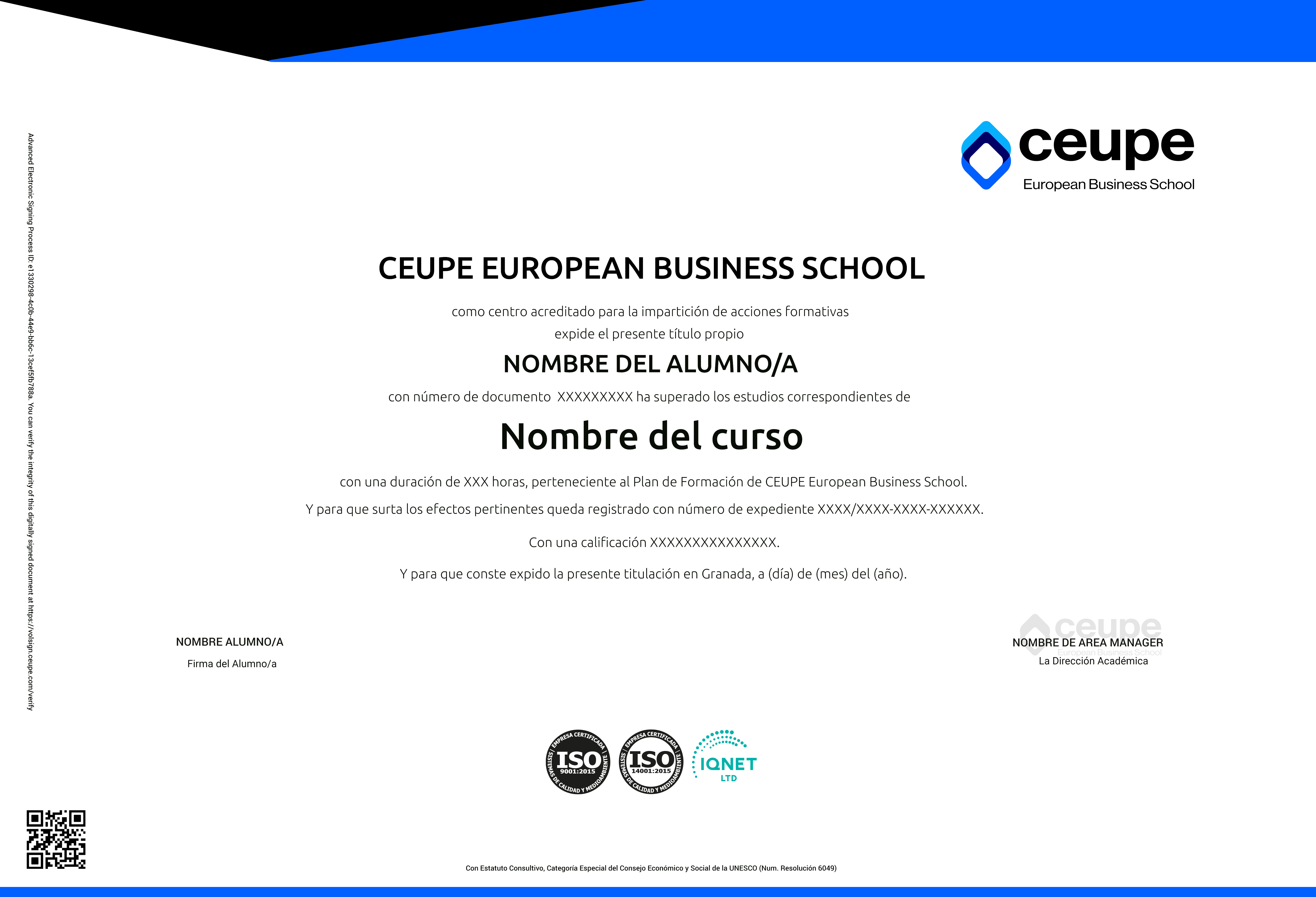
Digital certificate included
Assistant Phia
- Offer a general vision of the national economic environment and the operating mechanisms of our economic system. - Understand and develop the basic macroeconomic models used to analyze economic reality. - Know the most common concepts and variables used in economic analysis. - Learn to interpret the main structural and current indicators and statistics of the Spanish economy. - Introduce the student to basic economic concepts related to the international economy and relations between countries. - Know the functioning of the main agents that operate in financial markets - Understand the different financial markets, their main characteristics, their operation and the instruments and securities that are traded in them - Understand the basic concepts associated with foreign trade operations - Know the principles of international taxation and their impact on the company's income statement - Recognize the different existing credit rating agencies, as well as their functions and ratings - Understand financial derivatives as a hedging and investment tool
1. Banking entities. 2. Accounting departments. 3. Insurance companies. 4. Audits. 5. Finance departments of national and international companies.
This Diploma in International Financial Economics prepares the student to understand and manage economic and financial dynamics at a global level. Some of the skills and knowledge you will acquire: 1. Fundamentals of International Economics • International Trade Theory: Understanding of the models and theories of global trade. • International Economic Policy: Analysis of economic policies and their impact on global markets. 2. Global Financial Markets • International Financial Instruments: Knowledge of global financial products, such as currencies, bonds and stocks. • Capital Markets: Functioning of international capital markets and their regulation. 3. Financial Risk Management • Foreign Exchange Risk: Identification and management of the risk associated with currency fluctuations. • Credit and Liquidity Risk: Evaluation and mitigation of risks in the international context. 4. International Corporate Finance • International Investment and Financing: Strategies for investment and financing in international markets. • Global Capital Structure: Decisions about financing and capital structure in a global environment. 5. Monetary and Fiscal Policy • International Monetary Policy: Impact of the monetary policies of different countries on the global economy. • International Tax Policy: Effects of tax policies on international trade and investment. 6. Global Economic Analysis • Global Economic Indicators: Use and interpretation of economic indicators to make informed decisions. • Trends and Economic Cycles: Analysis of trends and economic cycles at a global level. 7. Technology and Global Economy • FinTech: Impact of financial technologies on global markets. • Big Data and Data Analysis: Use of big data and data analysis to forecast economic trends. 8. Ethics and Social Responsibility • Ethics in International Finance: Ethical practices in global financial management. • Corporate Social Responsibility (CSR): Implementation of CSR practices in an international context. 9. Professional Development • International Network of Contacts: Opportunities to establish a network of professional contacts at a global level. • Practical Experience: Participation in projects and real case studies in the field of international economics and finance.