Online Training
Master in Aerospace Engineering

1500 hours


Spanish
Educational institutions

£1,694
Request information


Online Training
1500 hours
Spanish
Educational institutions
Request information
Multilingual support
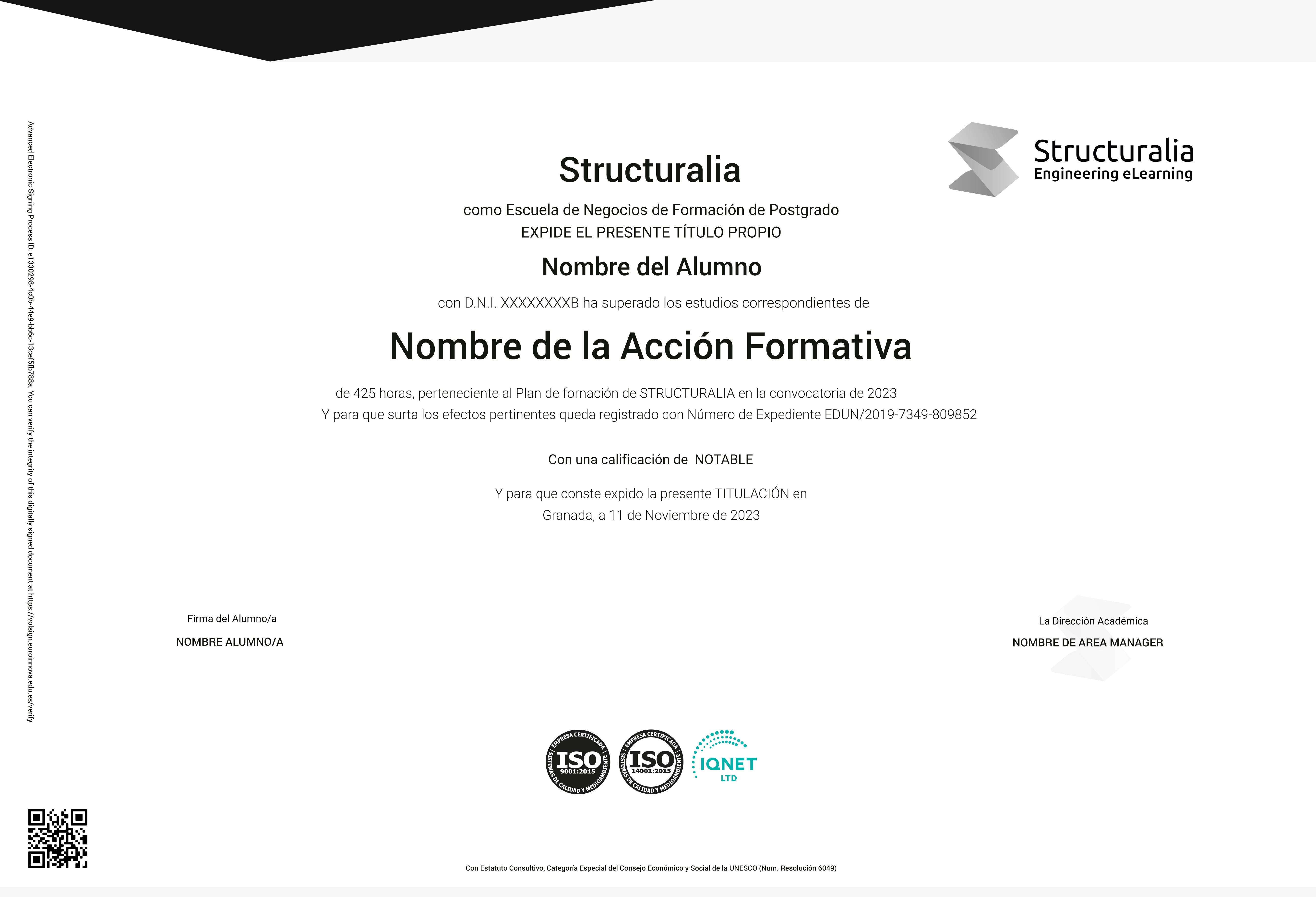
Digital certificate included
Assistant Phia
- Know the engines - Know the aerodynamics - Identify the airplane instruments - Navigation planning - Acquire the basic concepts of thermodynamics. - Know the thermodynamic criteria to work with temperature. - Know the basic mechanisms of heat transmission. - Know the principle of increase in entropy. - Acquire the three principles of thermodynamics. - Describe what aerodynamics is and the most basic related concepts. - Establish the difference between the main aerodynamic forces. - Establish the difference between a compressible and incompressible flow and relate them to bodies immersed in fluids. - Explain the aerodynamics that mainly affects the wing part of an aircraft. - Describe the main high-lift devices that aircraft can use to influence lift. - Explain how space vehicles and rocket vehicles act in the atmosphere. - Know the basic concepts of statistics, its functions and the measurement of data. - Correctly interpret statistical graphs and scientific notation. - Define the types of statistics as well as their variables, differentiate the types of events and the sampling method to be used. - Understand probability distributions and their types and use the necessary tools for their application. - Describe the Central Limit Theorem and its proof and know its development throughout history. - Contrast hypotheses using the appropriate specific method and define the parameters to identify them. - Understand linear regressions and their choice depending on the type of variable, as well as select the most appropriate variables for the construction of a regression model and its subsequent validation and interpretation. - Define and classify the different propulsion systems. - Understand the terms that affect propulsion systems. - Describe the types of rocket engines and the elements that make them up. - Understand the operation of thermal propulsion engines. - Differentiate the types of fuel to be used in a propulsion system. - Explain how electric motors work. - Know the types of electro-thermal motors. - Develop the applications of the different propulsion engines. - Define the aircraft. - Classify aerospace vehicles. - Know the use of metallic materials in aircraft. - Explain the behavior of non-metallic materials in space. - Understand the concept of space debris. - Apply current European regulations.
With this master's degree program in engineering, students will be able to obtain the necessary knowledge to complete their university degree studies and access a job in the following areas: Aeronautics / Physics / Thermodynamics / Expert in thermal balance / Aerodynamicist
The present Master in Aerospace Engineering will prepare you to know everything related to the Aerospace industry, acquiring, among others, specialized training in aerodynamics, propulsion systems, aerospace vehicles and concepts of aeronautics and thermodynamics. This is a master's degree program with which you can study engineering in relation to aircraft design, aeronautical manufacturing, aviation, etc. Contact us and a euroinnova training advisor will be able to resolve your queries and offer you complementary information about this and other master's degrees and complementary training programs that may be useful to you.