Online Training
Diploma in Business Marketing

500 hours


Spanish
Educational institutions

750€
Request information


Online Training
500 hours
Spanish
Educational institutions
Request information
Multilingual support
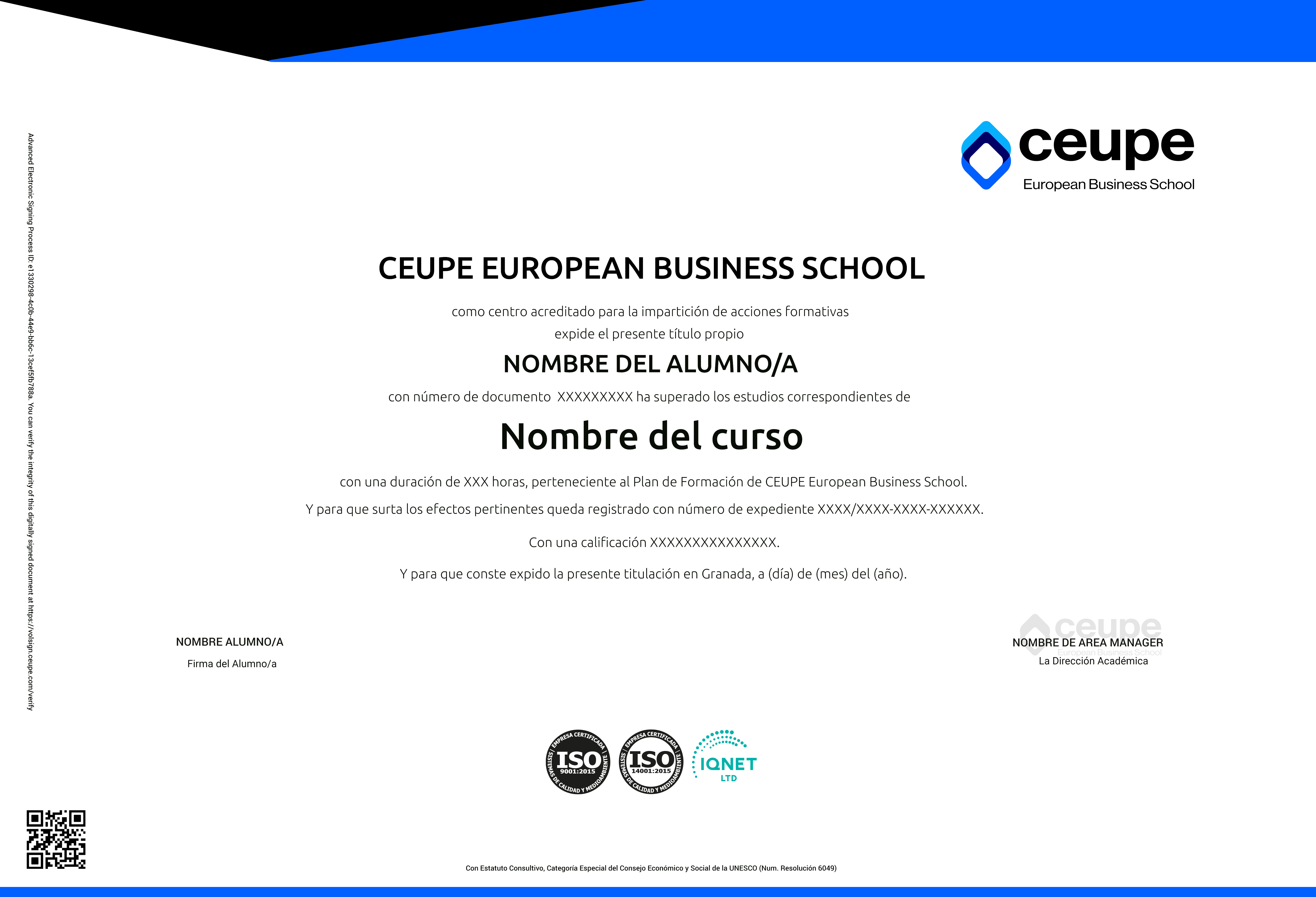
Digital certificate included
Assistant Phia
- Understand the fundamental elements of the environment and the historical development in which companies carry out their activity, as well as their impact on the various functional areas of the company. - Know what marketing is, its evolution over time and the main concepts of marketing as a discipline. - Internalize the role of marketing in a strategically market-oriented company, as well as discern between the activities of strategic marketing and operational marketing. - Know the marketing techniques available for decision making in organizations. - Know the tools that configure the marketing strategy in the company. - Formulate solutions related to the marketing practice in the company based on data. - Understand the environment and analyze content from various areas of knowledge with influence on the company. - Internalize critical thinking, the value of ethics and Apply basic theories and concepts about supply and demand to different types of companies, destinations and markets. - Design specific products, prices, distribution and communication in practice. - Know the different types of clients and their needs. - Understand and defend the use of Marketing in companies as a strategic and operational piece. - Know and know how to apply the operational variables of marketing and the most appropriate strategic combinations for each business situation (Marketing-Mix for launches, line expansions, introduction into unknown markets, distribution channels, efficient communication campaigns...). - Make the basic tools of operational marketing available to students to encourage their use in resolving strategic marketing situations. - Discuss the main challenge that Marketing faces in organizations and their environment. - Explain the purpose and objectives of modern Marketing. - Synthesize the main Marketing activities in your environment. - Describe the development of the variables that intervene in the strategic and tactical formulation of the Marketing Plan in an organization. - Determine the most appropriate mix possible of the variables Product, Price, Distribution, Processes, People and Communication. - Know the new forms of communication on the Internet and their influence in business environments. - Identify the most common Web 2.0 tools and their advantages for the company. - Take advantage of the phenomenon of social and professional networks: LinkedIn, Facebook, Twitter, Tuenti, etc. - Carry out a Communication campaign using social networks and Know the documents that make up the company's annual accounts, distinguishing the different items that make up each of them and assessing the type of information that 2.0 tools individually provide. - Disseminate corporate information and participate in online conversations about your services or products. - Detect the best ways to use blogs, microblogging, podcasts, and Wikis and their application in corporate environments. - Know the phases that must be followed for a correct implementation of Web 2.0 tools and avoid errors. - Analyze real cases that occur in the world of Social Media.
After completing this course, students will be able to put into practice the knowledge acquired in companies where marketing functions are being developed at a strategic and managerial level, combining approaches both online and outside the digital field. In addition, they will be able to work as professional salespeople, applying the new social marketing media available to today's society. The development of your work as a commercial specialist will be effective, being able to address the conflicts that commercial management and sales itself generate both internationally and nationally.
The Diploma in Business Marketing prepares the student for: Marketing Strategy • Strategic Planning: Develop and execute marketing plans aligned with business objectives. • Segmentation and Positioning: Identify and target specific target markets. Digital Marketing and Social Networks • Online Marketing: Use digital tools and social networks to promote products and services. • SEO and SEM: Optimize presence in search engines and manage online advertising campaigns. Sales and Customer Management • Sales Techniques: Implement effective sales strategies. • Customer Relationship Management (CRM): Manage customer relationships and loyalty. Research and Analysis • Market Research: Conduct studies to understand consumer behavior and market trends. • Data Analysis: Use analytical tools to measure campaign performance and make data-based decisions. Professional Development • Network of Contacts: Opportunities to establish professional contacts in the field of marketing. • Practical Experience: Application of knowledge in real projects and professional practices.